++++++++++++
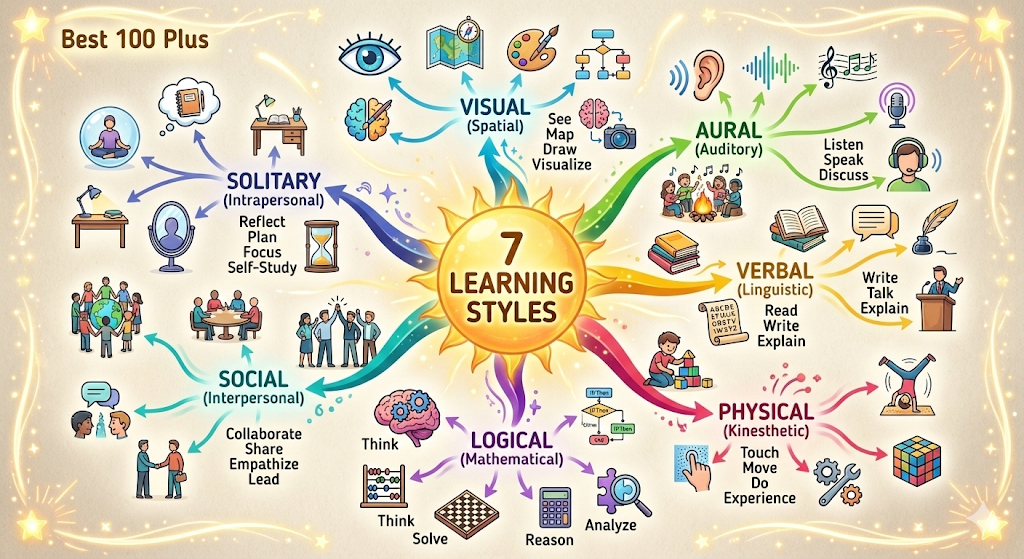
🌟 The 7 Learning Styles
- Visually (Spatial): I Learn best by seeing using pictures, images, diagrams, charts, colors, and mind maps. ++++
- Auditorily (Aural): I Learn best through hearing, listening, discussing, reading aloud, and recordings, sound, and music. Rhythm, rhyme, do um, hu, hum, or talk to my selves.
- Verbally (Reading/Writing): I Learn best with words, reading, writing notes, lists, speech, stories, and scripts. ++++
- Logically (Mathematical): I Learn best by reasoning, logic, steps, patterns, cause-and-effect, and the “why” of structured systems to explain and identify patterns in data.
- Physically (Kinesthetic): I Learn best by doing, hands-on practice, movement, role-play, experiments, and using my body and sense of touch to interact with the environment.
- Socially (Interpersonally): I Learn best through group study, teaching, teamwork, feedback, collaboration, and communication to share ideas.
- Personally (Solitary): Intrapersonally, I Learn best alone, self-study, private reflection, and working independently at my own pace are strengths.
- Habitually, experimentally, testing, examining, reality-based, scientifically, accuracy, righteousness, truthfulness, outcome, and result guarantee.
- Practically, actually,
- Naturally, Repeatually, Associationally, Impressionally, Preparationally. By using patterns, mnemonics, acronyms, formulas, rhythms, or rhymes to enhance memory, finding points, discovering, comprehension, understanding, and realization.
- Combinations: This model identifies four types of learners: visual, auditory, kinesthetic, and reading/writing. Most people are a combination of these four styles. Nearly 87% of participants identified as having a multimodal style of accessing information, with audio-kinesthetic and audio-read/write as the most common combinations,
+++++
Please edit, refine, polish, and, like a professional, rewrite the writing below, also add relevant adjectives:
The best gifts for information ages
The best gifts for information ages are the most valuable, lifelong gifts of knowledge. They are the practical ways it strengthens and enriches memory, nurtures deep insight, sparks discovery and vibrant creativity, sharpens comprehension, expands understanding, and reveals the enduring treasure of actual and true realization.
++++
Assign a specific emoji or icon to every, What exactly is an emoji?
An emoji ( im-OH-jee; plural emoji or emojis; uh·mow·jee) is a pictogram, logogram, ideogram, or smiley embedded in text and used in electronic messages and web pages.
spatial spa·tial /ˈspāSH(ə)l/
A citation sai·tay·shn/ is a reference to a source (author, date, title, etc.)
Aural = au·ral/ /ˈôrəl/
Recite = re·cite = /rəˈsīt/ repeat aloud or declaim (a poem or passage) from memory before an audience.”we provided our own entertainment by singing and reciting poetry.”
rhythm ri·thm, ri-dem
rhyme. rīm/ What is the meaning of in rhyme? Writtenor spoken as a poem so that the word at the end of a line has the same last sound as a word at the end of another line: A lot of modern poetry is not written in rhyme. The script is written entirely in rhyme.
++++
“Hum” humming refers to a low, continuous sound made with closed lips (like singing or a machine), a state of busy activity, or a persistent, low-frequency noise some people hear (The Hum) or uh, um
+++++
Becoming united and unified through one shared/ language, creating all together lovely one humanity, a singular community of one people, united and unified by one unifying language.
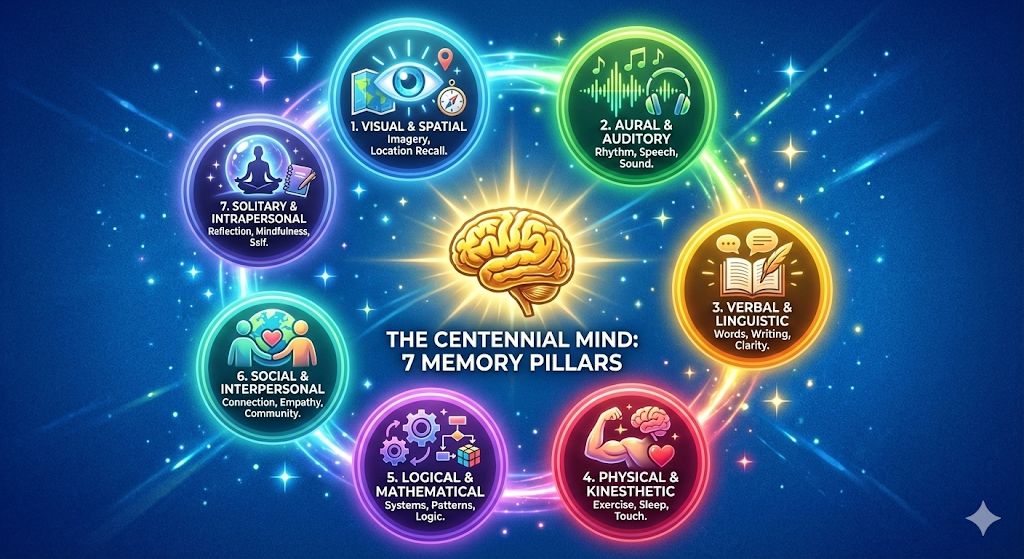
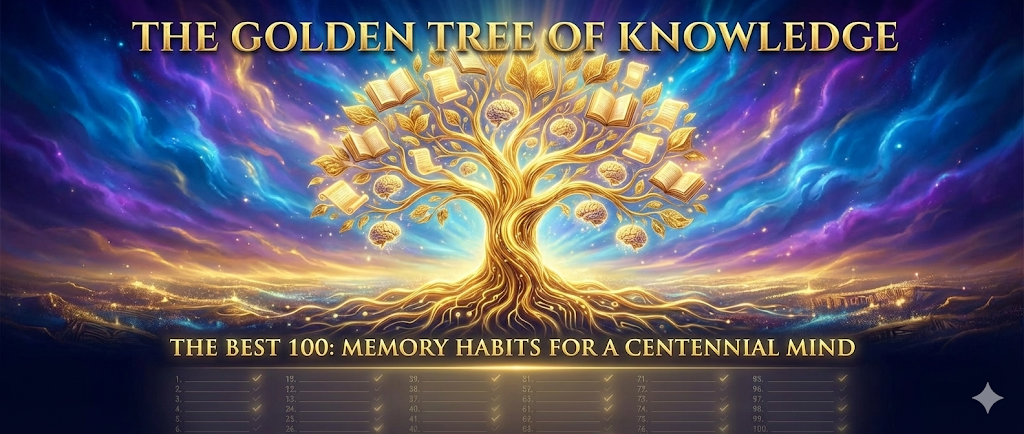
The Best 100: Memory Habits for a Centennial Mind
Pillar 1: Visual & Spatial Mastery (The “Mind’s Eye”)
- The Method of Loci (Mind Palace): Mentally place facts in a familiar room for retrieval.
- Color-Coded Recall: Assign specific colors to categories of information for visual cues.
- Visualization Sprints: Spend 5 minutes daily “seeing” your goals in vivid, bright detail.
- Sketchnoting: Turn meeting notes into colorful drawings rather than just standard text.
- Memory Anchors: Use physical objects to trigger specific, high-value memories.
- Navigation Without GPS: Navigate new routes using only a mental map to build spatial awareness.
- Iconic Association: Assign a specific emoji or icon to every person in your contact list.
- The “Snapshot” Technique: Blink your eyes like a camera to “capture” a scene mentally.
- Facial Mapping: Focus on one “shining” feature to anchor a new person’s name.
- Infographic Journaling: Summarize your week in a one-page, vibrant, colorful chart.
- Abstract Art Interpretation: Look at art to stimulate the visual cortex and lateral thinking.
- Mental Jigsaw Puzzles: Mentally rotate complex objects to keep the parietal lobe active.
- Bright Highlight Systems: Use fluorescent markers for the “Best 100” facts you read.
- Vision Board Review: Place your vision board where you see it first thing every morning.
- 3D Mental Modeling: Imagine how a complex problem looks from every possible angle.
Pillar 2: Aural & Auditory Harmony (The “Sound of Memory”)
- The “Recite & Repeat” Rule: Say a name three times immediately after hearing it.
- Mnemonic Songwriting: Set your “Top 10” daily tasks to a catchy, rhythmic tune.
- Record & Listen: Record your own explanations and listen to them during a walk.
- Audio-Guided Meditation: Use specific soundscapes to protect the hippocampus.
- Foreign Language Audibles: Listen to new languages to fire up fresh neural pathways.
- Active Listening Drills: Summarize what someone said back to them to ensure retention.
- The “Rhythmic Tapping” Method: Tap out a physical beat while memorizing a new list.
- Nature Sound Association: Associate specific tasks with environmental sounds like rain.
- Poetry Recitation: Memorize and recite one “Best” poem per month for rhythmic memory.
- The Sound Masking Technique: Use white or brown noise to block distractions during focus.
- Group Reading: Take turns reading aloud to engage deep auditory processing.
- Pitch Association: Associate high-pitch sounds with urgent tasks and low-pitch sounds with calm.
- Verbal Echoing: Mentally repeat instructions immediately after hearing them spoken.
- Classical Music Study: Use Mozart or Vivaldi to enhance spatial-temporal reasoning.
- Podcast Summaries: Record a 60-second “Best Takeaway” clip after listening to a show.
Pillar 3: Verbal & Linguistic Power (The “Written Legacy”)
- Daily “Golden Paragraph” Writing: Write daily about your best personal realization.
- + + The “Teach to Learn” Habit: Explain a new concept to a friend or an AI partner.
- Root Word Discovery: Learn Latin/Greek roots to expand your mental dictionary depth.
- Acronym Creation: Turn long lists into short, memorable, and “shiny” words.
- Gratitude Lettering: Write physical letters to foster social and verbal memory.
- Crossword Sprints: Solve a word puzzle daily to keep the prefrontal cortex agile.
- The “Word-a-Day” Challenge: Use a new, “radiant” adjective in every conversation.
- Bilingual Journaling: Write your daily grocery lists or goals in two different languages.
- Public Speaking Practice: Practice delivering information clearly to improve data structure.
- The “Six-Word Memoir”: Sum up your entire day in exactly six impactful words.
- Etymology Deep-Dives: Research word histories to create narrative anchors for meaning.
- Reading Before Bed: Replace digital screens with physical books for better retention.
- Self-Correction Drills: Search your “mental files” for 60 seconds before using a dictionary.
- The “Alliteration” Anchor: Use alliteration for your daily to-do lists to aid recall.
- Quote Collection: Keep a “Best 100 Quotes” notebook to revisit and memorize often.
Pillar 4: Logical & Mathematical Systems (The “Structured Mind”) - The “Chunking” Method: Group items into sets of 10 for easier logical recall.
- Flowchart Planning: Map out your projects using clear, logical flowcharts.
- Strategic Games: Play games that require predicting several moves ahead.
- The “Five Whys”: Ask “Why?” five times to find the logical root of a new fact.
- Statistical Tracking: Keep a spreadsheet of your personal best daily achievements.
- Coding Basics: Learn a simple programming language to train the brain in logic.
- Mental Math Sprints: Calculate your grocery total or restaurant tips in your head.
- Root Cause Analysis: Use diagrams to solve personal or business problems systematically.
- Categorical Thinking: Categorize objects in your room daily to sharpen logical sorting.
- The “If-Then” Habit: Set logical triggers (e.g., “If I eat, then I will read”).
- Sudoku Puzzles: Train the brain in deductive reasoning and pattern recognition.
- Financial Forecasting: Manage your own budget to keep your “number brain” sharp.
- Paradox Exploration: Read logical paradoxes to expand your critical thinking capacity.
- Algorithm Design: Create step-by-step checklists for your startup’s daily tasks.
- Pattern Spotting: Look for recurring patterns in your daily habits and note them.
Pillar 5: Physical & Kinesthetic Action (The “Body-Brain Connection”) - The “Aerobic Spark”: Do 20 minutes of cardio to increase brain-derived growth factors.
- Sleep-Sanctity: Prioritize 7–9 hours for essential nightly brain-toxin cleaning.
- Handwriting vs. Typing: Take notes by hand to encode memory more deeply.
- The “Walk & Talk”: Discuss important ideas while walking outdoors for oxygen flow.
- Gestural Learning: Use hand gestures to anchor new ideas in muscle memory.
- Dexterity Games: Learn to juggle or play an instrument to build new gray matter.
- Cold Plunges/Showers: Stimulate the nervous system for instant mental clarity.
- The “Aroma Anchor”: Use a specific scent, like Rosemary, while studying new data.
- Yoga for Focus: Use balancing poses like “Tree Pose” to strengthen the cerebellum.
- Hydration Ritual: Drink a glass of water first thing to hydrate your brain cells.
- Omega-3 Loading: Eat “Best” foods like walnuts and salmon to protect cell membranes.
- The “Finger-Tap” Focus: Tap each finger to your thumb when your focus begins to drift.
- Cooking from Memory: Recreate a complex recipe without looking at the book once.
- Tactile Exploration: Identify objects by touch with your eyes closed to sharpen senses.
- Power Napping: Take a 20-minute nap to boost afternoon cognitive function by 30%.
Pillar 6: Social & Interpersonal Connection (The “Social Glue”)
- Intergenerational Mentorship: Talk to someone 30 years older or younger every week.
- The “Storyteller” Habit: Turn every new fact you learn into a short, engaging story.
- Active Debate: Engage in respectful debates to challenge and anchor assumptions.
- Collaborative Problem Solving: Join a “Best 100” mastermind group for shared goals.
- The “Name-Face” Game: Quiz yourself on the names of people you met during the week.
- Empathy Mapping: Describe a situation from another person’s unique perspective.
- Volunteerism: Engage in public service to stimulate the brain’s reward center.
- Group Trivia Nights: Use social competition to spark fast memory recall skills.
- Family Tree Research: Memorize your heritage and tell the stories of your ancestors.
- Hosting Dinner Salons: Invite friends to discuss a specific “Topic of the Month.”
- The “Eye-Contact” Anchor: Maintain gentle eye contact to improve focus in conversation.
- Community “Best” Lists: Create “Top 100” lists together with family or colleagues.
- Conflict Resolution Practice: Use logical and social skills to navigate disagreements.
- Networking Sprints: Meet one new person a week and learn 3 “Best” facts about them.
- Shared Reading Clubs: Discuss books with others to gain diverse new perspectives.
Pillar 7: Solitary & Intrapersonal Reflection (The “Inner Core”)
- The “Evening Review”: Replay your entire day in your head like a movie before bed.
- Deep Meditation: Practice “Thought Observation” to reduce distracting mental noise.
- Purpose-Finding: Remind yourself of your “Why” for the UN 2045 goals every morning.
- The “Solitude Walk”: Walk alone for 30 minutes without any digital distractions.
- Journaling Your “Firsts”: Record every new experience to keep life feeling rich and long.
- Internal Dialogue: Ask “What did I learn today?” before you go to sleep each night.
- The “Stoic” Morning: Mentally rehearse how to stay calm during potential challenges.
- Mindfulness of the Senses: Focus on only what you smell or feel for one full minute.
- The “Best 100” Legacy List: Regularly update the things you want to be remembered for.
- The “Centennial Vow Daily”: Commit to being a lifelong student at any age or stage.
+

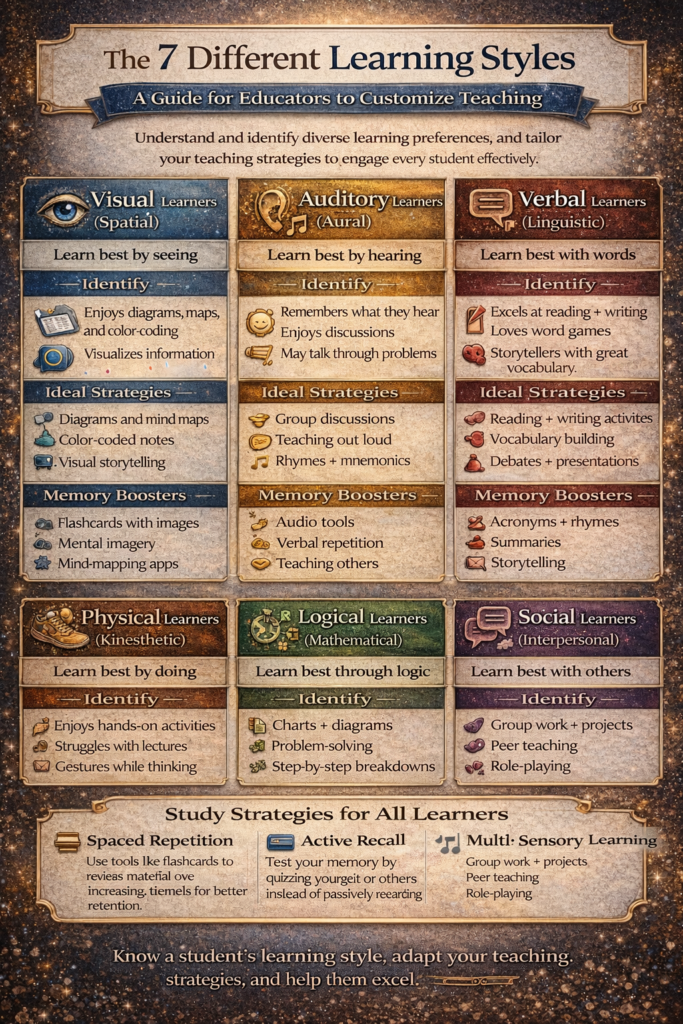
🌟 The 7 Learning Styles: A Complete Guide for Educators
1. Visual (Spatial) Learners
➤ Learn best through seeing
🔍 How to Identify:
- Enjoys diagrams, maps, charts, and color-coding
- Often visualizes information or “sees” ideas in their head
- Prefers reading or watching over listening
🎯 Teaching Strategies:
- Use infographics, diagrams, mind maps, and color-coded notes
- Encourage sketching or visual note-taking
- Incorporate visual storytelling, timelines, and flowcharts
🧠 Memory Tips:
- Use mental imagery or visual associations
- Create flashcards with pictures or diagrams
- Use apps like MindMeister or Canva to create visual study tools
2. Auditory (Aural) Learners
➤ Learn best through listening
🔍 How to Identify:
- Remembers spoken instructions better than written ones
- Enjoys discussions, lectures, music, or audiobooks
- May talk through problems or read aloud while studying
🎯 Teaching Strategies:
- Use group discussions, lectures, and podcasts
- Encourage reading aloud or using rhythmic mnemonics
- Add music, rhyme, or rhythm to content for retention
🧠 Memory Tips:
- Record lessons or key ideas and listen to them repeatedly
- Use verbal repetition and audio study tools
- Teach back—explain the concept aloud to someone else
3. Verbal (Linguistic) Learners
➤ Learn best through words (spoken or written)
🔍 How to Identify:
- Loves reading, writing, word games, and storytelling
- Strong vocabulary and interest in language-based activities
- Excels at expressing thoughts through writing or speech
🎯 Teaching Strategies:
- Use reading assignments, essays, journaling, debates, and scripts
- Encourage summarizing or rewriting notes in their own words
- Include vocabulary building activities and language games
🧠 Memory Tips:
- Create acronyms, rhymes, or word associations
- Write summaries or concept explanations
- Teach others using well-structured explanations
4. Physical (Kinesthetic) Learners
➤ Learn best through movement and hands-on experience
🔍 How to Identify:
- Struggles with long lectures or passive learning
- Enjoys building, touching, role-playing, or physical activity
- Often gestures or fidgets when thinking or speaking
🎯 Teaching Strategies:
- Incorporate hands-on activities, experiments, role-play, and models
- Use movement-based games or simulations
- Encourage learning through real-world application (field trips, labs)
🧠 Memory Tips:
- Act out scenes or use body-based memory cues
- Use physical flashcards or manipulatives
- Combine movement with content (e.g., walk while reviewing notes)
5. Logical (Mathematical) Learners
➤ Learn best through logic, reasoning, and systems
🔍 How to Identify:
- Enjoys patterns, problem-solving, and numbers
- Likes organizing, classifying, or categorizing information
- Asks deep “why” or “how” questions
🎯 Teaching Strategies:
- Use charts, graphs, statistics, formulas, and coding exercises
- Break down concepts into structured steps
- Use logic puzzles, flowcharts, and problem-solving challenges
🧠 Memory Tips:
- Create logical frameworks (e.g., cause-effect maps, sequences)
- Develop concept maps or decision trees
- Use systems like the Feynman Technique (teach it back simply)
6. Social (Interpersonal) Learners
➤ Learn best through interaction with others
🔍 How to Identify:
- Prefers group activities, discussions, and peer feedback
- Learns by teaching, collaborating, or brainstorming
- Sensitive to others’ emotions and communication styles
🎯 Teaching Strategies:
- Use group projects, peer teaching, collaborative debates
- Create learning teams or study groups
- Facilitate discussion-based or role-playing activities
🧠 Memory Tips:
- Use discussion-based reviews
- Engage in interactive Q&A sessions
- Collaborate on mind-mapping or shared note-taking
7. Solitary (Intrapersonal) Learners
➤ Learn best alone and through self-reflection
🔍 How to Identify:
- Prefers independent study and self-paced learning
- Enjoys journaling, self-goals, or introspective activities
- Highly self-motivated and self-aware
🎯 Teaching Strategies:
- Allow for independent research and quiet study time
- Use goal-setting, learning journals, and reflection prompts
- Offer personalized assignments or self-assessment tools
🧠 Memory Tips:
- Reflect through journaling or self-quizzing
- Use personal examples or connections to remember facts
- Create a self-study schedule with meaningful goals
🧠 How to Help Students Learn, Memorize, and Remember
Whether you’re teaching one learning style or a mix, these strategies support long-term retention for everyone:
🔁 Spaced Repetition
- Review material at increasing intervals to move it into long-term memory (use tools like Anki or Quizlet).
🧠 Multi-Sensory Learning
- Combine visual + auditory + physical elements to reinforce content in different parts of the brain.
✍️ Active Recall
- Instead of rereading, test yourself or others. It’s far more effective for memory retention.
🗂️ Chunking
- Break large information into smaller, meaningful chunks (e.g., 3–5 points at a time).
🧩 Personal Connection
- Link new concepts to personal experiences or emotions to deepen memory formation.
🧭 Self-Reflection
- Use metacognition: teach students to reflect on how they learn and what works best for them.
✅ Summary Chart
| Learning Style | Learns Best Through | Ideal Strategies | Memory Boosters |
|---|---|---|---|
| Visual | Seeing | Diagrams, mind maps, color-coding | Flashcards, visual mnemonics |
| Auditory | Hearing | Lectures, discussions, audio tools | Repetition, teaching out loud |
| Verbal | Words (spoken/written) | Reading, writing, language games | Acronyms, summaries, storytelling |
| Kinesthetic | Movement, doing | Hands-on activities, role-play | Acting out, physical cues |
| Logical | Reasoning, systems | Patterns, frameworks, problem-solving | Concept maps, steps, structured review |
| Social | Interaction | Group work, discussions, collaboration | Peer teaching, shared tools |
| Solitary | Self-study | Journaling, goal-setting, reflection | Personalized study routines |
Roses, SmartRosy Story263
++++++++++++++++++++++++
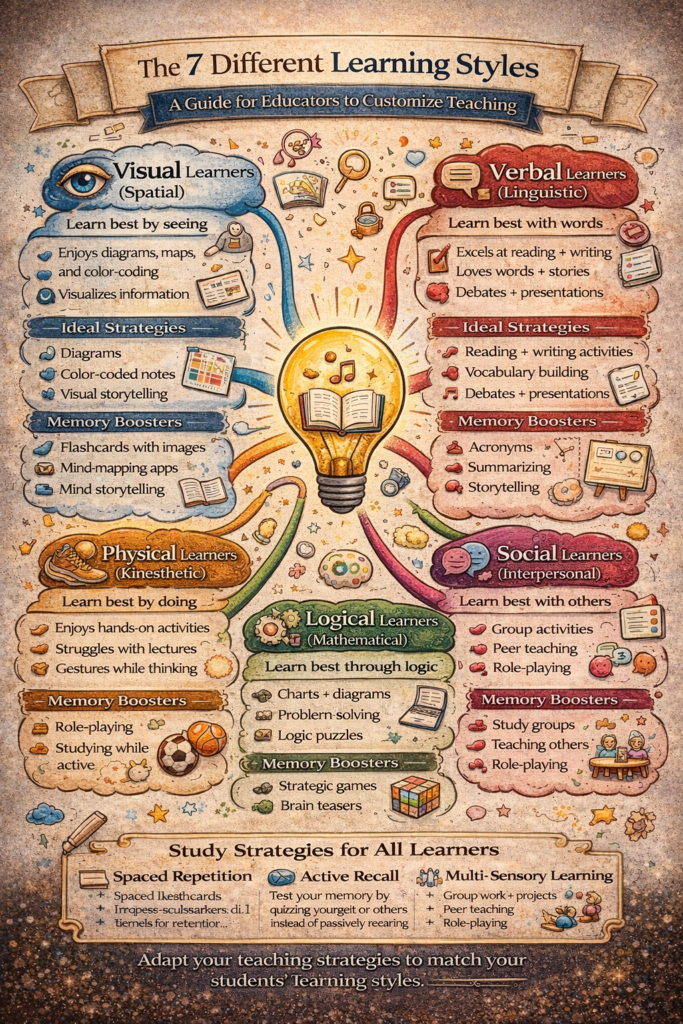
Understanding diverse learning styles is a cornerstone of modern pedagogy. By identifying how a student naturally processes information, educators can shift from a “one-size-fits-all” approach to a more radiant and personalized instruction model.
The following overview covers the 7 key learning styles, how to spot them in a classroom or workspace, and the most effective ways to teach them.
Overview of the 7 Learning Styles
| Learning Style | Core Preference | How to Identify Them | Effective Teaching Strategies |
| 1. Visual (Spatial) | Uses pictures, images, and spatial understanding. | They often doodle, have a strong sense of direction, and prefer “seeing” a task before doing it. | Use maps, infographics, color-coded notes, and whiteboard demonstrations. |
| 2. Aural (Auditory) | Uses sound, rhythm, and music. | They hum, talk to themselves, and remember names better than faces. They are easily distracted by noise. | Incorporate podcasts, audio recordings, rhymes, and rhythmic patterns into lessons. |
| 3. Verbal (Linguistic) | Uses words—both in speech and writing. | They love reading, telling stories, and have a wide vocabulary. They often excel at word games. | Use essays, scripts, debates, and asking students to “explain it in their own words.” |
| 4. Physical (Kinesthetic) | Uses the body, hands, and sense of touch. | They “talk with their hands,” find it hard to sit still, and prefer trying things out physically. | Use role-playing, hands-on experiments, and “walk and talk” study sessions. |
| 5. Logical (Mathematical) | Uses logic, reasoning, and systems. | They search for patterns, ask “Why?” frequently, and enjoy puzzles, numbers, and strategy games. | Provide flowcharts, structured agendas, and problem-solving scenarios with clear rules. |
| 6. Social (Interpersonal) | Prefers learning in groups or with other people. | They are “people persons,” show high empathy, and seek feedback or collaboration constantly. | Utilize group projects, breakout rooms, peer-to-peer teaching, and social forums. |
| 7. Solitary (Intrapersonal) | Prefers to work alone and use self-study. | They are introspective, independent, and often keep journals or private reflection logs. | Offer independent research, personal reflection journals, and quiet self-paced modules. |
Strategies for Learning & Remembering the Styles
To help you and your fellow educators memorize these styles for the UNESCO 2030 goals or your own Best 100 lists, try these “Best 100 Plus” tips:
- The “VAV-LPSP” Mnemonic: Think of the acronym VAV-PLSS (pronounced like “Valve-Plus”):
- Visual
- Aural
- Verbal
- Logical
- Physical
- Social
- Personal
- The “Sensory Trio” + “Mind Trio”: Group them to simplify.
- Sensory: Visual, Aural, Physical (How we sense the world).
- Mind: Logical, Verbal (How we process the world).
- Environment: Social, Solitary (Where we learn best).
- Flashcard Practice: Create a set of 7 colorful flashcards. On one side, draw a symbol (e.g., a 🔍 for Visual, a 👂 for Aural) and on the other, write the teaching strategy. This is a classic Physical/Visual learning technique!
Important Note for 2025 Educators
Current research (and organizations like the Education Endowment Foundation) suggests that while students have preferences, they are rarely limited to just one style. The “Best” approach is Multimodal Learning: presenting the same information through at least three different styles (e.g., a video [Visual/Aural] followed by a group discussion [Social] and a written summary [Verbal]).
Pro-Tip: For your website,www.best100plus.com, you could create a “Top 100 Learning Tools” list, categorized by these styles, to help visitors find the right apps or books for their specific needs.
+++++
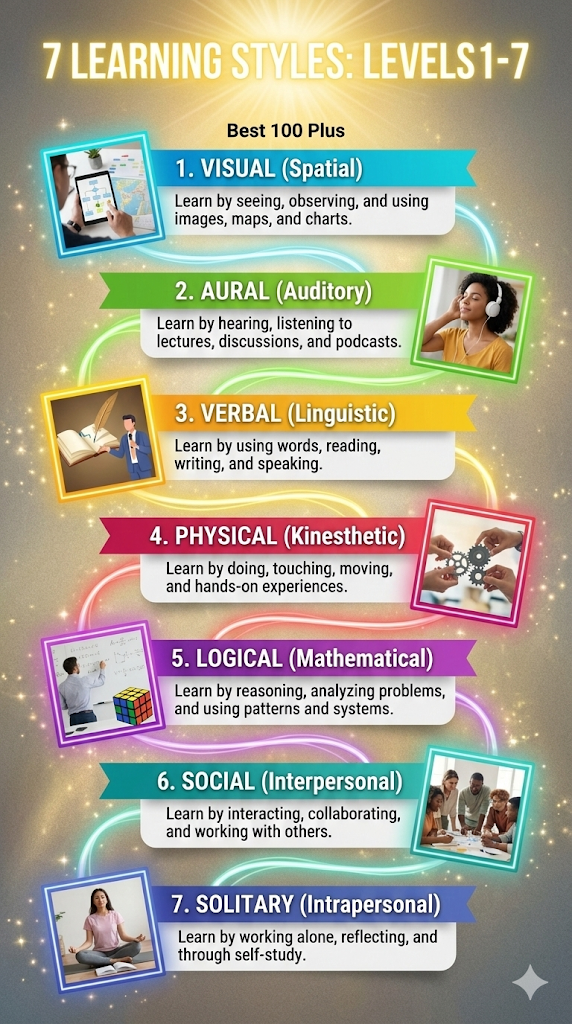
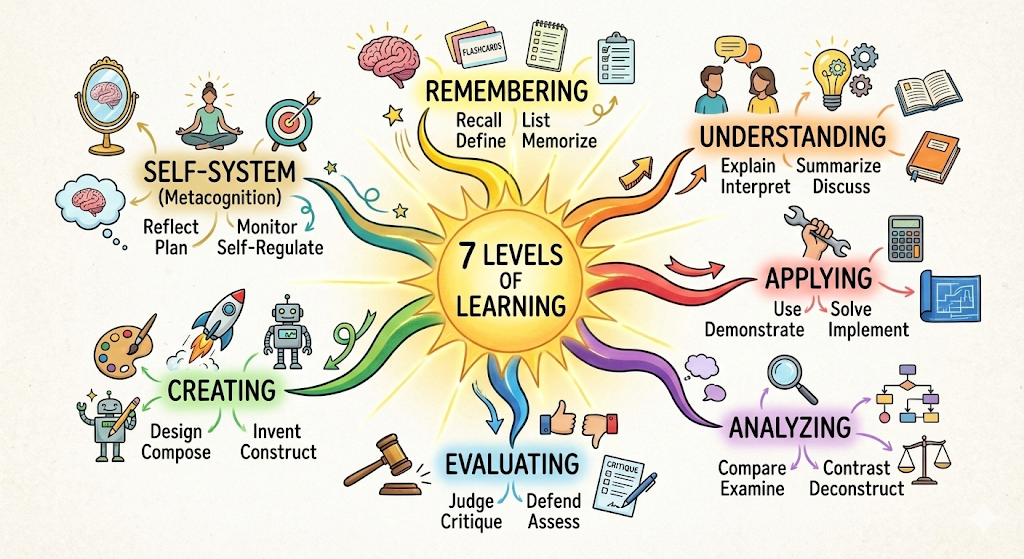
+++The 7 Levels of Learning: A Best 100 Plus Guide
Discover how you process the world. Use this list to identify your top 3 styles and optimize your personal growth!
1+ Visual (Spatial): You prefer using pictures, images, and spatial understanding. You see the “big picture” literally!
2+ Aural (Auditory-Musical): You prefer using sound and music. Rhythm and tone are your keys to memory.
3+ Verbal (Linguistic): You prefer using words, both in speech and writing. Stories and scripts are your playground.
4+ Logical (Mathematical): You prefer using logic, reasoning, and systems. You thrive on patterns and “why.”
5+ Physical (Kinesthetic): You prefer using your body, hands, and sense of touch. You learn by doing.
6+ Social (Interpersonal): You prefer to learn in groups or with other people. Collaboration is your fuel.
7+ Solitary (Intrapersonal): You prefer to work alone and use self-study. Reflection and independence are your strengths.
8+ Actually,
9+ Practically
10+ Naturally, Repeatually, Associationally, Impressionally, Preparationally, patterns, mnemonic, or acronym, formula, rhythm, rhyme,
++🚀++🌟 Unlock Your Learning Superpower! 🚀🌟+++
++++++++
+++++
human behaviour, ability lost by losing memory and remembering or learning abilities by alzheimer, amnesia, dementia or silar disabilites
Losing memory or learning abilities due to conditions like Alzheimer’s, dementia, and amnesia leads to a progressive loss of human behavior and functional skills
. While amnesia primarily targets memory, Alzheimer’s and other dementias eventually affect nearly all cognitive and physical abilities.
Loss of Functional Abilities (ADLs & IADLs)
Functional decline typically follows a sequence, starting with complex tasks and moving to basic survival skills.
- Instrumental Activities (Early-Middle Stages): The ability to manage finances, drive, cook complex meals, follow multi-step instructions (e.g., a recipe), and manage medications is often lost first.
- Basic Activities (Late Stages): Eventually, individuals lose the ability to perform “self-care” tasks, including dressing, bathing, maintaining personal hygiene, and eating.
- Physical Control: In severe stages, the ability to walk, sit upright, and eventually swallow is lost, leading to complete dependence on others.
Behavioral and Personality Changes
As the brain’s control centers (like the frontal lobe) degenerate, human behavior significantly alters:
- Emotional Dysregulation: Increased irritability, anxiety, depression, and uncharacteristic outbursts of anger.
- Apathy and Withdrawal: Loss of motivation (“spark”), social withdrawal, and a lack of interest in previously enjoyed hobbies.
- Inappropriate Behavior: Loss of social inhibitions can lead to rude, insensitive, or impulsive actions.
- Confusion and Paranoia: Disorientation regarding time and place can lead to wandering, pacing, and suspiciousness (e.g., believing others are hiding their things).
- Sensory Changes: Impairment in the sense of smell is often one of the earliest signs of Alzheimer’s.
Cognitive and Learning Impairments
- New Information: In typical Alzheimer’s and anterograde amnesia, the ability to “record” and learn new events or facts is lost, while long-term memories may remain temporarily intact.
- Language (Aphasia): Difficulty finding words, following conversations, or understanding speech becomes more pronounced over time.
- Problem Solving: The central executive system fails, making it hard to plan, focus, or multitask.
- Judgment: Impairment in the ability to make safe or logical decisions, such as dressing inappropriately for the weather or giving away money.
Remaining Abilities (Strengths)
Even in advanced stages, certain human abilities often persist:
- Emotional Memory: A person may forget a visitor’s name but still feel the positive (or negative) emotional impact of the interaction.
- Musical and Artistic Skills: Memories for music and practiced skills (like playing an instrument) are often less damaged and can be a source of connection late into the disease.
- Humor and Emotions: The capacity for humor, affection, and a full range of emotions often remains even after verbal communication is lost.
This is for informational purposes only. For medical advice or diagnosis, consult a professional. AI responses may include mistakes. Learn more